
Police report writing is a critical skill, demanding accuracy and clarity. Resources like LAPD guidelines and sample forms (available as PDFs) aid officers in documenting incidents effectively.
Importance of Accurate and Detailed Reports
Detailed police reports are foundational to the justice system, serving as official records of events. Accuracy ensures successful prosecutions and protects individual rights. Comprehensive documentation, often exemplified in police report writing examples found as PDFs from agencies like the LAPD, minimizes ambiguity and supports legal proceedings.
Thorough reports aid investigations, allowing for pattern identification and resource allocation. They also demonstrate departmental transparency and accountability. Access to well-structured PDF templates and guidelines, such as incident report forms, empowers officers to create legally sound and informative documentation. Failing to provide precise details can hinder investigations and compromise the pursuit of justice, highlighting the vital role of meticulous report writing.
Legal Basis and Admissibility of Reports
Police reports possess significant legal weight, often serving as crucial evidence in court. Their admissibility hinges on adherence to established legal standards and departmental policies. Properly documented reports, mirroring structures found in police report writing examples – often available as PDF guides from departments like the LAPD – are more likely to be accepted.
Accuracy, objectivity, and a clear chain of custody are paramount. Reports must withstand scrutiny during cross-examination. Utilizing standardized forms and following best practices, detailed in PDF templates, strengthens their legal standing. Inaccurate or incomplete reports can be challenged, potentially jeopardizing cases. Therefore, understanding the legal implications of report writing is essential for all law enforcement personnel.

Essential Components of a Police Report
Reports require header details, officer information, and a narrative. Examining police report writing examples – often found as PDFs – clarifies these elements for effective documentation.
Header Information: Case Number, Date, Time, Location
Crucially, a police report’s header establishes its foundational context. This section must include a unique case number for tracking, the precise date of the incident (e.g., 03/08/2026), and the exact time (e.g., 19:33:13).
Detailed location information is also paramount – street address, city, and any relevant landmarks. PDF examples of police report writing, such as those from the LAPD, consistently demonstrate this standardized format.
Properly completed header information ensures efficient retrieval and analysis of reports. Reviewing sample incident report forms (available as PDFs) illustrates how these elements are consistently presented for clarity and accountability.
Reporting Officer Information: Name, Badge Number
Essential for accountability and report validity, this section clearly identifies the officer responsible for the documentation. It must include the officer’s full legal name and their assigned badge number. This information allows for easy identification and follow-up if questions arise regarding the report’s content.
PDF examples of effective police report writing, like those provided by the LAPD, consistently showcase this detail.
Accurate reporting officer information is vital for legal proceedings and internal reviews. Sample arrest report templates (often available as PDFs) emphasize the importance of this section, ensuring a clear chain of responsibility throughout the investigation.
Narrative Section: Chronological Account of Events
This is the core of the police report, detailing the incident’s unfolding in a clear, sequential manner. Officers must present facts objectively, avoiding assumptions or personal opinions. Begin with the initial dispatch and proceed through each event as it occurred, using timestamps where possible.
Police report writing examples, often found as PDF guides from agencies like the LAPD, demonstrate this structure.

A well-written narrative uses plain language and avoids jargon. Incident report forms (available as PDF templates) often provide prompts to guide officers in constructing a comprehensive and easily understandable account of the events.

Types of Police Reports
Police report writing examples, often in PDF format, showcase diverse report types: incident, arrest, and supplemental reports, each serving unique documentation needs.
Incident Reports: Common Offenses and Disturbances
Incident reports meticulously document everyday occurrences, ranging from minor disturbances to common offenses like theft, vandalism, or simple assaults. Examining police report writing examples – frequently available as PDF downloads from agencies like the LAPD – reveals a standardized structure for these narratives.
These reports prioritize a clear, chronological account of events, detailing the who, what, when, where, and how of the incident. PDF samples demonstrate the inclusion of victim and witness statements, property descriptions, and any evidence collected. Effective incident reports avoid subjective language, focusing instead on observable facts. Understanding these examples is crucial for new officers learning to accurately and comprehensively document these frequent calls for service, ensuring a solid foundation for potential investigations.
Arrest Reports: Detailing the Arrest Process
Arrest reports are legally significant documents meticulously outlining every step of the arrest process. Accessing police report writing examples, often found as PDF templates, is vital for proper completion. These reports detail the probable cause for the arrest, the suspect’s Miranda rights advisement, and a comprehensive description of the arrest itself – including any use of force.
PDF samples showcase the inclusion of information regarding search warrants (if applicable), evidence seized, and the suspect’s statements. Accuracy is paramount; these reports are frequently scrutinized in court. Best practice PDF guides emphasize objective language and a clear timeline of events. Thorough documentation, mirroring established examples, protects both the officer and ensures due process for the arrested individual.
Supplemental Reports: Follow-up Investigations and New Information
Supplemental reports document ongoing investigations, adding to the initial incident or arrest report. Finding police report writing examples in PDF format is crucial for understanding their structure. These reports detail new evidence discovered, witness interviews conducted, and any changes in the case’s status. They are essential for building a comprehensive case file.
PDF templates often illustrate how to clearly link the supplemental report to the original case number. They emphasize concise summaries of follow-up activities and any resulting conclusions. Utilizing established PDF examples ensures consistency and completeness. Accurate and timely supplemental reporting is vital for effective prosecution and maintaining a transparent investigative record.

Key Elements of Effective Report Writing
Effective reports prioritize objectivity, clarity, and accuracy, mirroring standards found in police report writing examples often available as PDF guides.
Objectivity and Impartiality: Avoiding Bias

Maintaining objectivity is paramount in police report writing. Reports must present facts without personal opinions or biases influencing the narrative. Utilizing descriptive language, focusing on observable behaviors, and avoiding subjective interpretations are crucial. PDF examples from agencies like the LAPD demonstrate this principle through neutral phrasing and detailed accounts.
Impartiality ensures fairness and credibility. Officers should report all relevant information, even if it contradicts initial assumptions. Examining police report writing examples in PDF format reveals how professionals document all perspectives encountered during an investigation. Avoiding loaded language or assumptions about a suspect’s guilt is essential for legal defensibility and public trust. A biased report can jeopardize a case and undermine the integrity of the justice system.
Clarity and Conciseness: Using Plain Language
Clear and concise writing is vital for effective police reports. Avoid jargon, complex sentence structures, and ambiguous language; Reports should be easily understood by all readers, including those without legal training. Examining police report writing examples, often available as PDFs from various departments, highlights the use of straightforward language.
Conciseness doesn’t mean omitting crucial details; it means presenting them efficiently. Every sentence should contribute to the overall narrative. PDF guides, such as those from the LAPD, emphasize the importance of direct communication. Using active voice and avoiding unnecessary words improves readability. A well-written report facilitates accurate information sharing and strengthens the case’s foundation.
Accuracy and Completeness: Verifiable Details
Police reports must be meticulously accurate and complete, forming a permanent record of events. All details should be verifiable, supported by evidence or witness statements. Utilizing police report writing examples – often found as PDF resources from agencies like the LAPD – demonstrates best practices for documentation.
Completeness involves including all relevant information, even seemingly minor details, as they may prove crucial later. PDF templates and guidelines stress the importance of thoroughness. Avoid assumptions and document only facts. Accuracy builds credibility and ensures the report’s admissibility in court. A comprehensive report strengthens investigations and supports just outcomes.
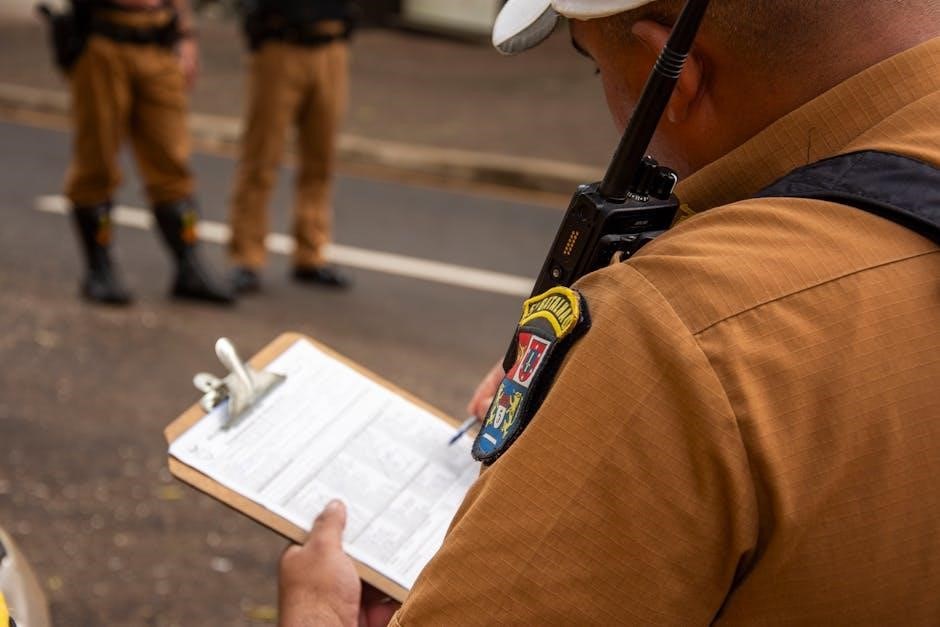
Specific Examples & PDF Resources
PDF resources, including LAPD report guidelines and sample incident forms, offer practical police report writing examples for officers seeking clarity and standardization.
LAPD Report Examples and Guidelines (PDF)
The Los Angeles Police Department provides valuable PDF resources for mastering police report writing. These documents showcase exemplary reports, offering practical insights into structuring narratives and documenting crucial details. LAPD guidelines emphasize objectivity, accuracy, and completeness – cornerstones of legally sound reports.
Accessing these PDFs allows officers to study real-world applications of report writing principles. They demonstrate proper formatting, appropriate language, and the inclusion of essential information like case numbers, dates, times, and locations. Furthermore, the LAPD examples illustrate how to effectively convey complex situations in a clear and concise manner, vital for investigations and potential legal proceedings. These resources are regularly updated to reflect current best practices and legal requirements.
Sample Incident Report Forms (PDF)
Numerous law enforcement agencies offer PDF versions of their standard incident report forms. These templates provide a structured framework for documenting a wide range of events, from minor disturbances to more serious offenses. Utilizing these PDF forms ensures consistency and completeness in reporting.
These sample forms typically include sections for victim and witness information, detailed descriptions of the incident, property damage or loss, and any actions taken by the responding officer. Studying these PDF examples helps officers understand the specific information required for each type of incident. Properly completed forms are crucial for investigations, statistical analysis, and legal proceedings, offering a clear record of events as they unfolded.
Arrest Report Templates and Best Practices (PDF)
PDF arrest report templates are vital for meticulously documenting the arrest process, ensuring legal defensibility. These forms typically detail the probable cause for the arrest, the suspect’s rights (Miranda warning), a description of any resistance encountered, and a list of seized property. Accessing these PDFs allows officers to familiarize themselves with required elements.
Best practice guidelines, often included alongside the templates, emphasize the importance of accurate and objective reporting. Thorough documentation minimizes ambiguity and strengthens the case for prosecution. Properly completed arrest reports, available as PDFs, are essential for court proceedings and internal agency reviews, demonstrating adherence to legal standards and departmental policies.

Common Mistakes to Avoid in Police Report Writing
PDF examples highlight avoiding subjectivity, grammatical errors, and omissions. Thoroughness and objectivity are key; review PDF guidelines for best practices in report creation.
Subjectivity and Opinions
Police reports must present facts, not personal interpretations. Utilizing PDF examples from agencies like the LAPD demonstrates objective language. Avoid phrasing that implies judgment or bias; stick to observable details. For instance, instead of stating “the suspect appeared nervous,” report “the suspect’s hands were shaking and they avoided eye contact.”
PDF training materials emphasize reporting what happened, not what you think happened. Opinions weaken credibility and can jeopardize legal proceedings. Carefully review sample incident reports (often available as PDFs) to identify and eliminate subjective statements. Focus on verifiable information, ensuring the report reflects an impartial account of events, free from personal feelings or assumptions.
Grammatical Errors and Poor Spelling
Police report accuracy extends beyond factual correctness to include impeccable grammar and spelling. Reviewing PDF examples of well-written reports, such as those provided by the LAPD, highlights proper usage. Errors undermine professionalism and can create ambiguity, potentially impacting investigations or legal outcomes.
Utilize spellcheck and grammar tools, but don’t rely on them solely. Carefully proofread each report before submission. Many agencies offer PDF-based style guides and training materials addressing common errors. A clear, concise report, free of grammatical flaws, demonstrates attention to detail and respect for the legal process. Sloppy writing can cast doubt on the entire investigation.
Omissions of Crucial Details
A comprehensive police report necessitates including all pertinent details, no matter how seemingly insignificant. Examining PDF examples – like incident report forms and LAPD guidelines – reveals the level of detail expected. Failing to document key information can hinder investigations, jeopardize prosecutions, and compromise officer safety.
Omissions might include witness statements, specific descriptions of evidence, or precise locations. Thoroughness is paramount. Referencing available PDF templates ensures all necessary sections are addressed. Remember, a report is often the only record of an event; incomplete information can lead to misinterpretations and ultimately, injustice. Always strive for a complete and accurate account;

Technological Advancements in Report Writing
Mobile reporting and digital dictation streamline documentation, while RMS integration enhances efficiency. PDF examples demonstrate evolving report formats and data capture.
Mobile Reporting Applications
Mobile reporting applications represent a significant leap forward in police documentation, allowing officers to create and submit reports directly from the field. These applications often feature user-friendly interfaces designed for quick data entry, reducing the time spent on paperwork and increasing officer visibility. Many incorporate GPS tagging for precise location data and allow for the inclusion of photographic or video evidence directly into the report.
Access to PDF examples of reports generated via these apps showcases the standardized formats and detailed information captured. The ability to instantly transmit reports to dispatch and supervisors improves situational awareness and facilitates faster response times. Furthermore, mobile reporting enhances data accuracy by minimizing transcription errors and ensuring reports are completed while details are still fresh in the officer’s mind. These tools are becoming increasingly essential for modern law enforcement.
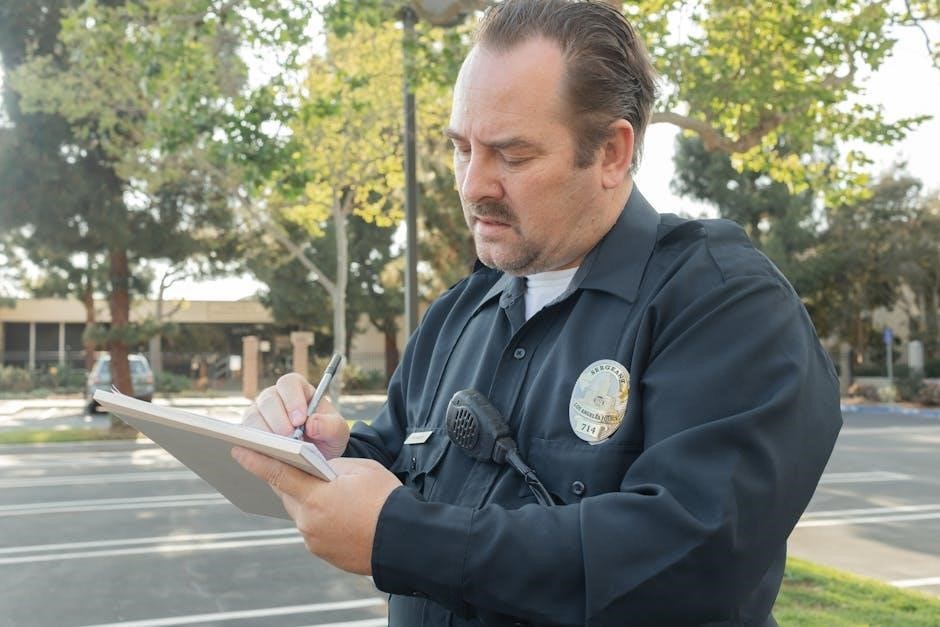
Digital Dictation and Speech-to-Text Software
Digital dictation and speech-to-text software are transforming police report creation, offering a faster and more efficient alternative to traditional typing. Officers can verbally narrate incident details, which are then automatically transcribed into written reports. This technology is particularly valuable during or immediately after dynamic events when detailed recall is crucial.
Reviewing PDF examples of reports created using these methods demonstrates the clarity and comprehensiveness achievable. Accuracy is continually improving with advancements in voice recognition technology. Integration with Record Management Systems (RMS) streamlines the workflow, ensuring seamless data transfer. Utilizing these tools reduces administrative burdens, allowing officers to dedicate more time to proactive policing and community engagement, ultimately enhancing public safety.
Record Management Systems (RMS) Integration
Record Management Systems (RMS) are central to modern policing, and seamless integration with report writing tools is paramount. RMS platforms store, organize, and analyze vast amounts of data, including police reports. Direct integration minimizes redundant data entry, reducing errors and saving valuable time.
Analyzing PDF examples of reports within an RMS context reveals standardized formats and efficient data retrieval. This integration facilitates data-driven policing, enabling agencies to identify trends, allocate resources effectively, and improve crime prevention strategies. RMS also ensures compliance with legal and regulatory requirements regarding data retention and access. A well-integrated system enhances transparency and accountability within the department.